How I contributed to a 75-year old math problem using AI
2026-07-29
I am a psychologist, not a math expert. But I like trying my hand at various fields.
I recently heard this crazy story that directly inspired me to do this. There is an Anthropic employee, who use Claude to disprove the decades old Jacobian conjecture while watching the FIFA finale.
I had tried something similar recently, but didn't get much success. But getting access to Fable made me try again. Even though, Opus turned out to be enough for this.
I contributed to 2 problems. I am extremely happy! It's crazy to think that using AI, we can tackle such difficult problems, without being experts!
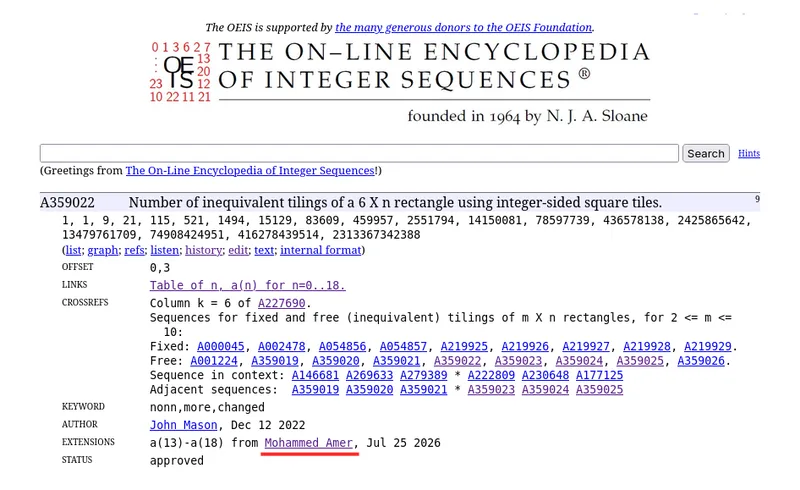
For the OEIS sequence, a part of what I did is already published.
For the Hadwiger problem, the 75 year old one, I have submitted a note for publishing.
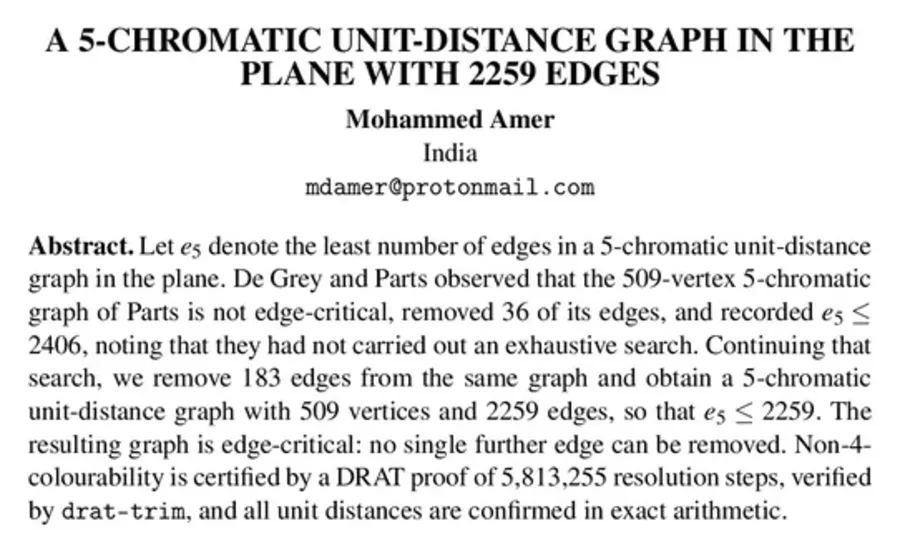
The paper I submitted to Geombinatorics:
As I depended heavily on Claude to understand, analyse and compute, I will let it explain:
The two problems, explained
1. OEIS sequence extension. A family of sequences (A359019-A359026) counts the ways to tile a rectangle with square tiles, ignoring rotations/reflections. Only a handful of terms were known, since the old method (direct enumeration) gets exponentially slower with size. I built a transfer-matrix method combined with Burnside's lemma (a standard way to count "up to symmetry") that computes 500 terms per row in about a minute. Every new term was checked against the previously published terms, an independent brute-force check on small cases, and known symmetry relations between rows and columns. One extension (A359022) is reviewed and live, credited to me; a few more are still in the review queue.
2. Hadwiger-Nelson problem. This asks: coloring every point on the plane so points exactly 1 unit apart differ, what's the fewest colors needed? Known since 1950 to be between 5 and 7, still unresolved. In 2018, Aubrey de Grey proved it's at least 5 using a 1,581-point graph. In 2020, Jaan Parts found a smaller one, 509 points, still the smallest known. In 2022, de Grey and Parts noted this graph had unnecessary connections, removed 36, reaching 2,406, and admitted they hadn't done an exhaustive search for more.
I picked up that search. For each connection, a SAT solver checks: can the graph still be colored with 4 colors if this one is removed? If not, it's deleted for good. I removed 183 connections (not 36), reaching 2,259, a new record: e5 <= 2259.
Verification, since I can't check this by hand: every remaining connection reconfirmed at exactly distance 1 using exact arithmetic (no rounding); non-4-colorability confirmed independently by four SAT solvers and a formal proof certificate, checked by an independent tool that replayed 5,813,255 resolution steps; every one of the 2,259 connections individually tested to confirm none can be removed further; the same code reproduces the exact counts of 43 previously published graphs from this research line. Everything is public: https://github.com/md-amer/hadwiger-nelson-e5
What the experts said. I contacted both researchers before writing this up.
De Grey:
"The discovery of a set of removable edges that's more than five times larger than the one Jaan found is for sure a remarkable result. Unless Jaan has more information, it's probably worth submitting to Geombinatorics."
Parts:
"Your result is likely the best so far. I'm not aware of anyone publishing research in this direction."
Submitted to Geombinatorics; not yet accepted. This does not solve Hadwiger-Nelson, and it doesn't establish the lower bound of 5 for the first time (de Grey did that in 2018) — it's one specific improvement to a previously published number.
References
- A. de Grey, The chromatic number of the plane is at least 5, Geombinatorics 28 (2018), 18-31. arXiv:https://arxiv.org/abs/1804.02385.
- J. Parts, Graph minimization, focusing on the example of 5-chromatic unit-distance graphs in the plane, Geombinatorics 29 (2020), 137-166. arXiv:https://arxiv.org/abs/2010.12665.
- A. de Grey and J. Parts, On lower bounds of the order of k-chromatic unit distance graphs, Geombinatorics 32 (2022), 72-74. arXiv:https://arxiv.org/abs/2303.14714.
- Data, code, verification scripts: https://github.com/md-amer/hadwiger-nelson-e5
- OEIS: https://oeis.org/A227690